

Introduction
In modern software-defined data centers, network and security teams face a persistent operational paradox: development teams require autonomous agility to provision networking constructs at software speed, while corporate InfoSec cannot sacrifice baseline compliance, auditability, or emergency containment capabilities.
Historically, multi-tenant network security suffered from two architectural extremes:
- Centralized Bottlenecks: SecOps manually reviewed, ticketed, and provisioned every segment and firewall rule, introducing weeks of friction into developer release pipelines.
- Ungoverned Sprawl: Tenants were granted unfettered administrative access to shared network domains, leading to misconfigured boundaries, unmonitored egress paths, and accidental rule overrides.
VMware Cloud Foundation (VCF) 9.1 resolves this fundamental conflict through hierarchical multi-tenancy: pairing NSX Projects, Virtual Private Clouds (VPCs), vDefend Distributed Firewall (DFW), and Transit Gateways (TGWs). By locking down immutable enterprise guardrails in the Provider Default Space and delegating micro-segmentation down to Project VPCs, enterprises achieve true decentralized operations governed by centralized security.
The Paradigm Shift: From Monolithic DFW to Project-Scoped VPCs
In traditional NSX environments, the Distributed Firewall was treated as a monolithic engine. All firewall sections—regardless of whether they protected core active directory controllers or ephemeral test databases—lived in a single policy table. As organizations scaled to hundreds of tenants and thousands of workloads, this created severe operational strain:
- Rule tables expanded past thousands of lines, complicating change windows and auditing.
- Overlapping RFC 1918 subnets across business units were impossible to isolate without complex NAT schemes.
- An error in an application rule could unintentionally intercept or bypass traffic for another business unit.
The VCF 9.1 Project & VPC Abstraction Model
VCF 9.1 introduces a native hierarchical multi-tenancy model that decouples infrastructure administration from tenant workload operations:
Capture 1: –
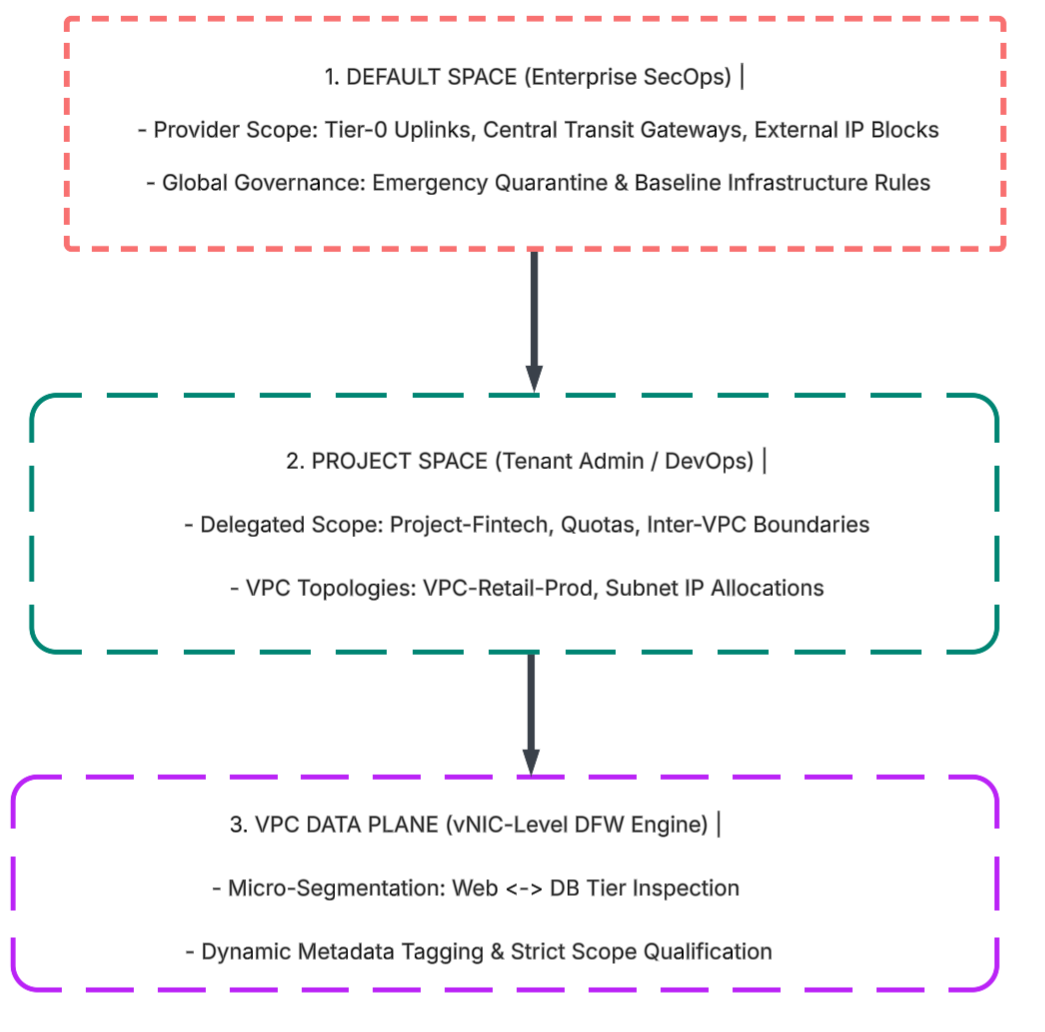
- Default Space (Provider Layer): Owned by enterprise SecOps and cloud admins. Controls physical transport nodes, Tier-0 Gateways, Centralized Transit Gateways, and global DFW policies.
- Project Space (Tenant Layer): Delegated to business units or product teams[cite: 2]. Tenants receive resource quotas (number of VPCs, Tier-1 routers, IP blocks) and operate within their own isolated RBAC boundary.
- VPC Workload Tier (Distributed Data Plane): Created within projects to host applications. Tenants provision self-service subnets and define application-level micro-segmentation policies without administrative escalation.
Policy Hierarchy & Rule Governance Across VPC Boundaries
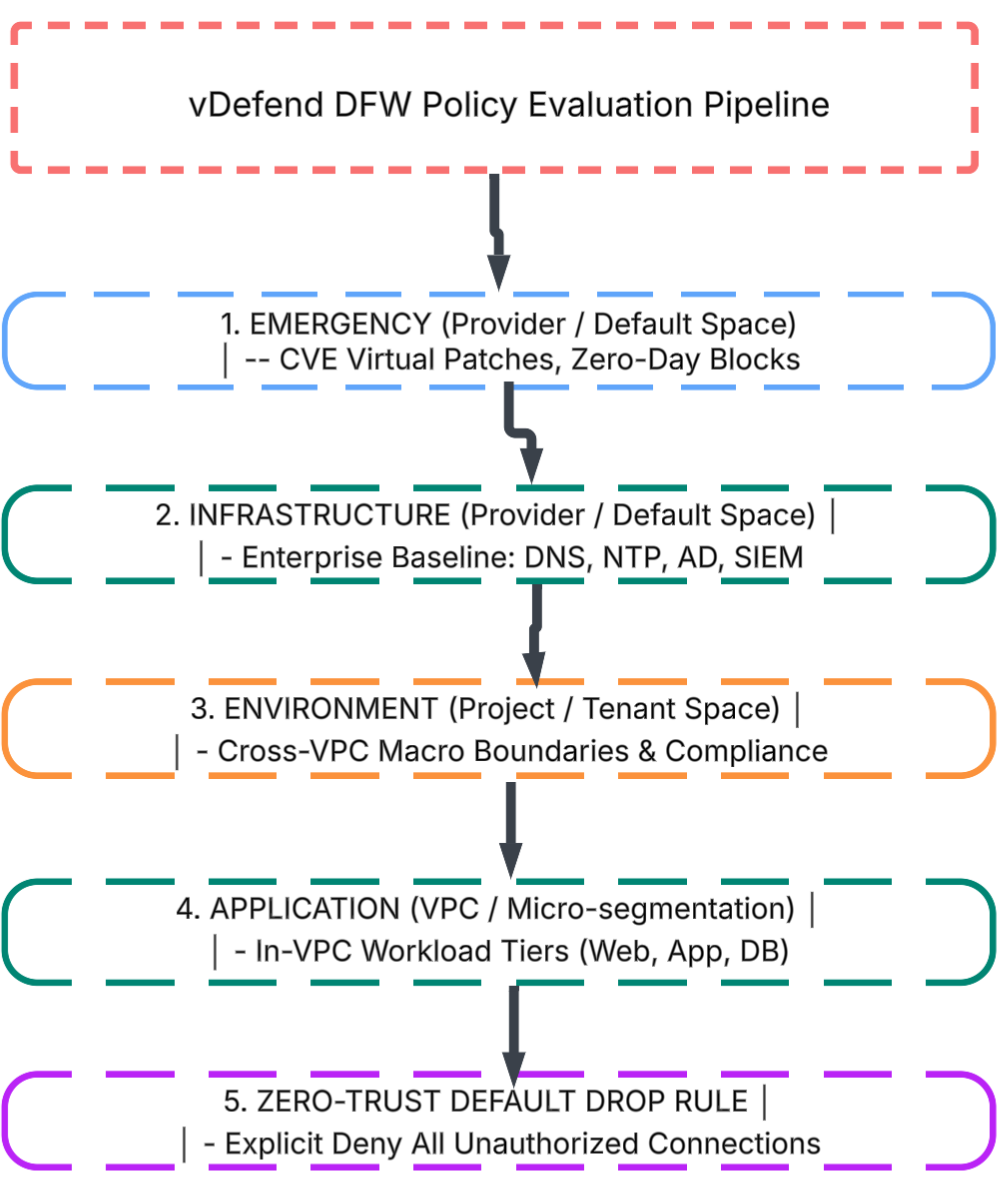
NSX achieves zero-trust isolation without tenant interference through category-based deterministic precedence. Firewall categories are evaluated sequentially inside the ESXi kernel IOChain at the virtual machine vNIC level
Why This Hierarchy Guarantees Compliance
Provider Overrides Tenant: Rules defined in the Default Space (Emergency and Infrastructure) are compiled and evaluated before any rule configured in the Project Space. A tenant administrator cannot bypass or disable an enterprise guardrail.
Selective Category Exposure: In the Project Space UI, the Emergency category is completely hidden from view. While the Infrastructure category is visible to allow project-local infrastructure services, Default Space infrastructure policies execute ahead of tenant policies.
Scoped Applied-To Enforcement: DFW rules are not pushed globally across all hypervisors. Rules are compiled and distributed strictly to the vNICs of workloads included in the rule’s Applied To scope, optimizing CPU efficiency and memory footprint on ESXi transport nodes.
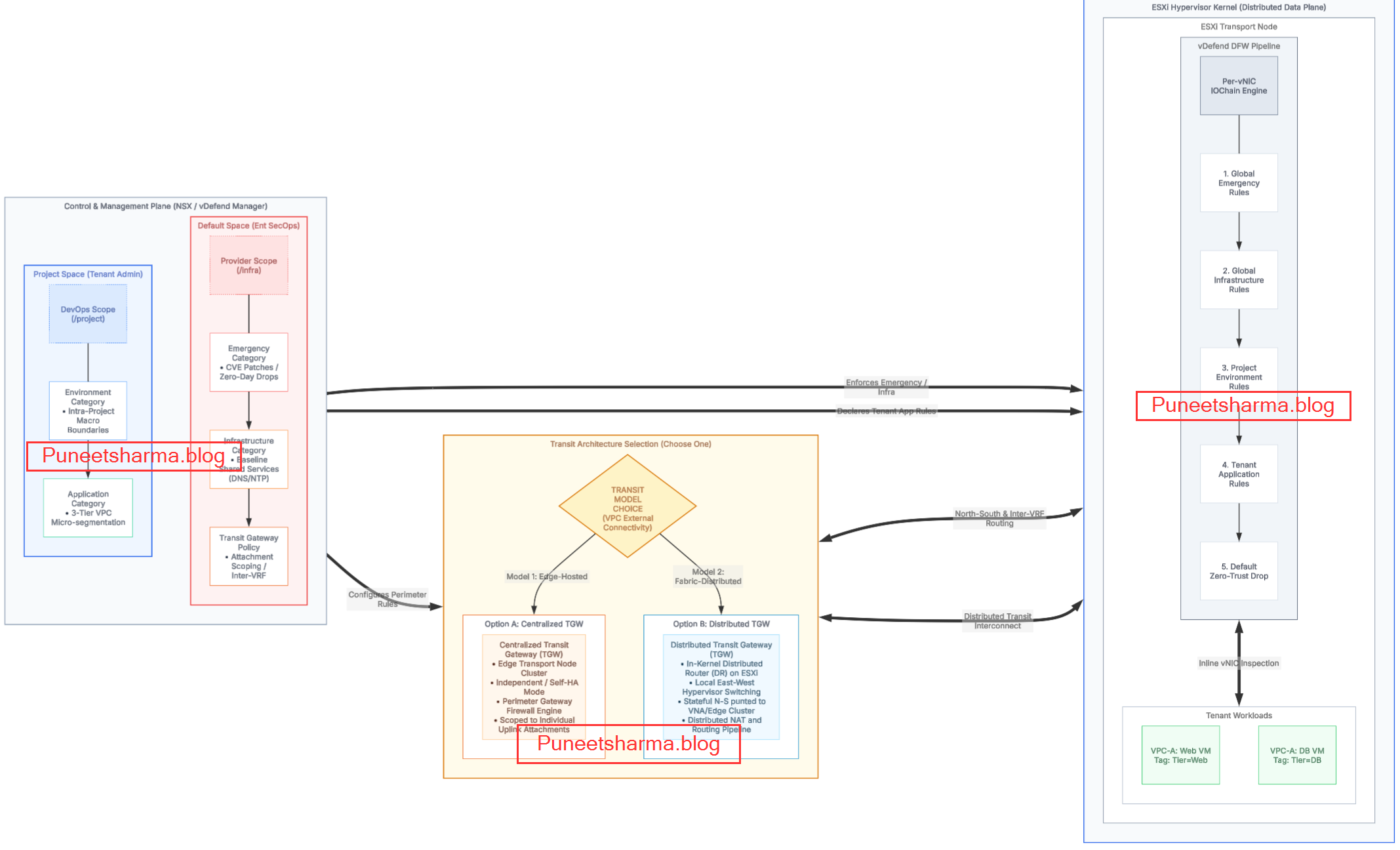
Architecture Blueprint: Centralized Governance Meets Distributed Enforcement
The following diagram illustrates how global compliance policies set by central SecOps and delegated micro-segmentation rules set by tenant admins are compiled and enforced directly at the hypervisor vNIC layer:
Capture 1: –
Key Architectural Challenges & Solutions
| Architecture Challenge | Traditional Shared Tier-1 / Segment Design | Unregulated Decentralized Tenancy | Governed NSX Projects & VPC Hierarchy | Operational & Security Impact |
| 1. Policy Precedence & Guardrails | Flat rule lists. Central rules risk accidental override, deletion, or re-ordering during tenant updates. | Tenants control entire firewall; global security baselines cannot be programmatically enforced. | Category-Based Deterministic Precedence: Emergency ——–> Infrastructure——– ——-> Environment——->Application. | Central SecOps retains absolute, overriding enforcement. Provider rules execute before tenant rules can evaluate. |
| 2. Dynamic Group Scoping with Overlapping CIDRs | IP-based groups cause severe cross-tenant policy bleed when RFC 1918 subnets overlap. | Independent NSX domains require costly dedicated Edge and Manager clusters per tenant. | Metadata Tagging with Strict Scope Binding: Dynamic tags enforce boundaries (e.g., Tag: Web | Scope: VPC-Retail-Prod). | Prevents lateral policy contamination. Identical subnets in different VPCs remain strictly isolated. |
| 3. Administrative Isolation (RBAC/Tenancy) | Role-Based Access Control lacks resource scoping; tenants see other tenants’ inventory. | Multiple NSX Manager deployments introduce operational sprawl and high licensing overhead. | Native Multi-Tenancy (Projects): Role-mapping restricts tenant views to authorized VPC constructs. | Tenant admins view and configure only their own subnets, groups, and micro-segmentation policies. |
| 4. Edge Scalability & Transit Routing | Monolithic Tier-0/Tier-1 gatekeeper architectures introduce CPU bottlenecks and routing table exhaustion. | Uncontrolled Edge deployments lead to uncoordinated BGP peering and route table bloat on physical switches. | Centralized Transit Gateways (CTGW): Independent HA mode with attachment-level policy scoping. | Offloads East-West VPC routing to hypervisors while centralizing North-South perimeter and Inter-VRF inspection. |
| 5. Auditability & Observability | Centralized logs blend tenant traffic; separating audit trails requires external SIEM post-processing. | Fragmented logs across disparate management appliances delay mean-time-to-resolution (MTTR). | Tenant-Aware Telemetry & Traceflow: Real-time visibility into per-vNIC DFW rule hits and VPC drop states. | Instantly distinguishes between routing misconfigurations (IP_OUT_OF_SCOPE) and security policy drops. |
Field Implementation
Companion Runbook: To track parameters, tags, and rule IDs during deployment, open the companion
Step 1: Establish the Enterprise Guardrail (Default Space)
Even though core shared services (DNS/NTP) reside on external or management subnets, enforcement occurs at the workload vNIC on the Workload Domain ESXi host. We establish global allow rules in the Provider Default Space to ensure baseline services succeed regardless of downstream tenant configurations.
Capture 1: –
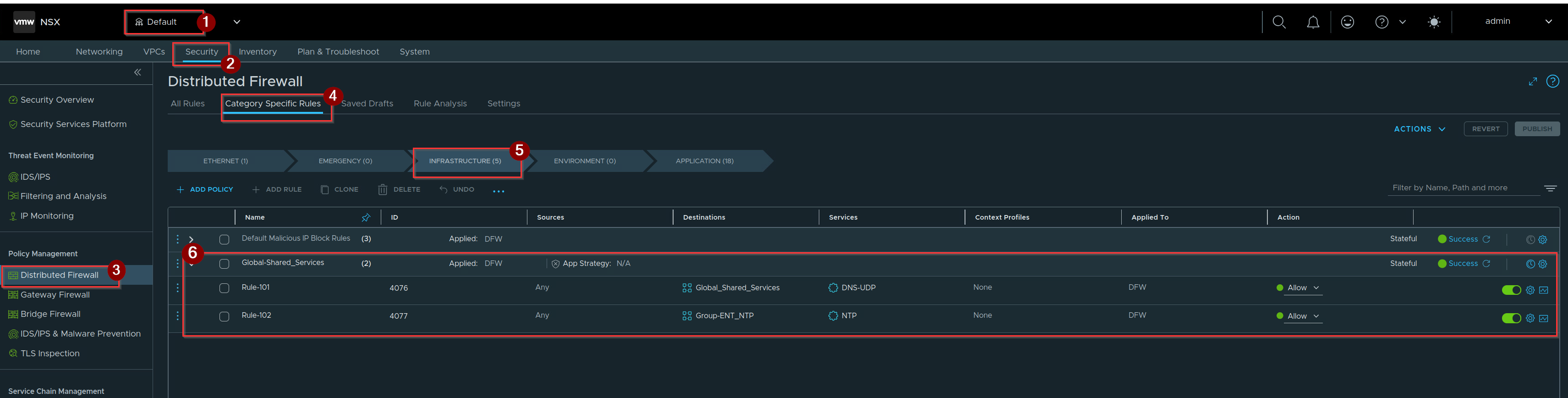
- Select the default Space.
- Click on Security.
- Click on Distributed Firewall under policy management.
- Click on category specific rules.
- Click on Infrastructure.
- Create the DNS & NTP rule & Click Publish.
Note: – Every workload across all projects can now reach central infrastructure services. Because these rules exist in the Default Space Infrastructure category, no tenant admin can override or disable them.
Step 2:Provision Tenant VPC and Subnets (Project Space)
We now switch context to the delegated project space to construct the tenant network topology.
Capture 1:-
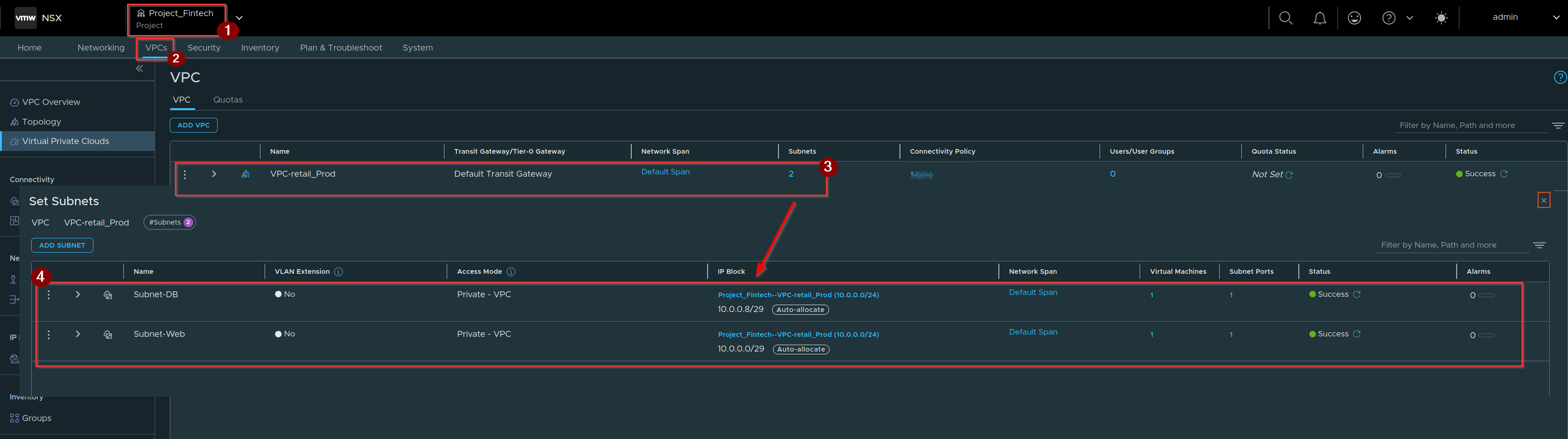
- Create the Project.
- Click on VPCs.
- Create the VPC.
- Added 02 subnet (Web & DB)under the VPC.
Note: – NSX provisions the VPC gateway and automatically realizes the corresponding distributed portgroups on the vSphere Distributed Switch (VDS).
Step 3: Implement Tenant Micro-Segmentation
With the subnets created, we apply granular micro-segmentation between our Web and DB tiers.
Capture 1: –
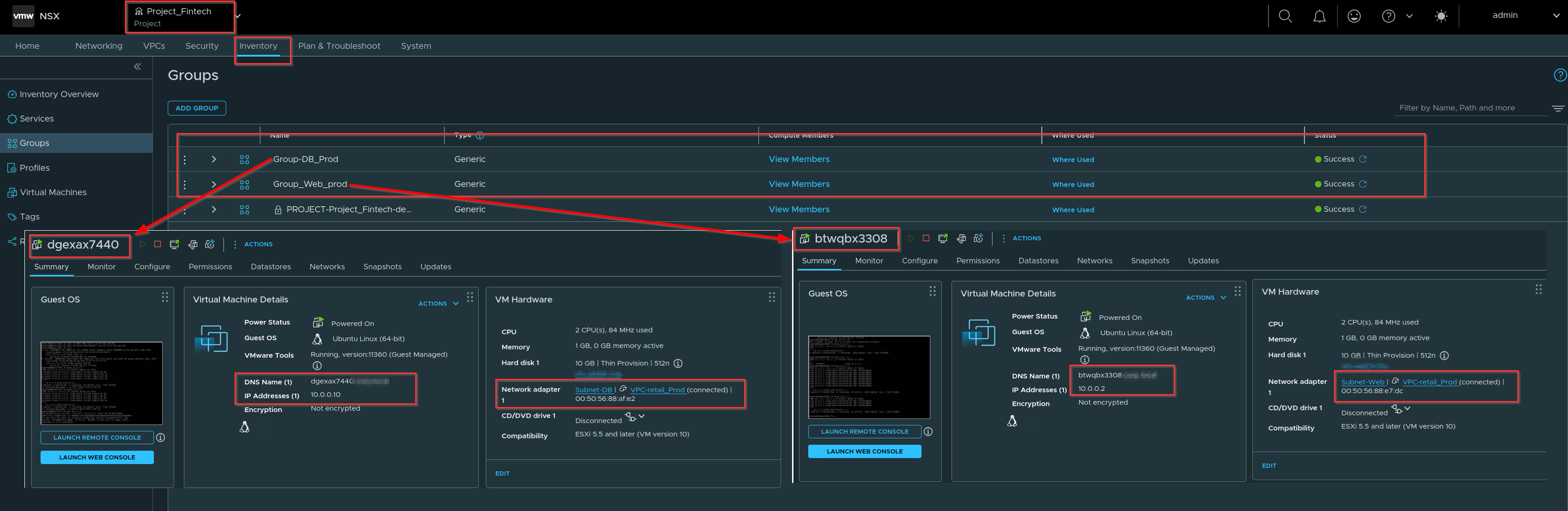
Capture 2:-
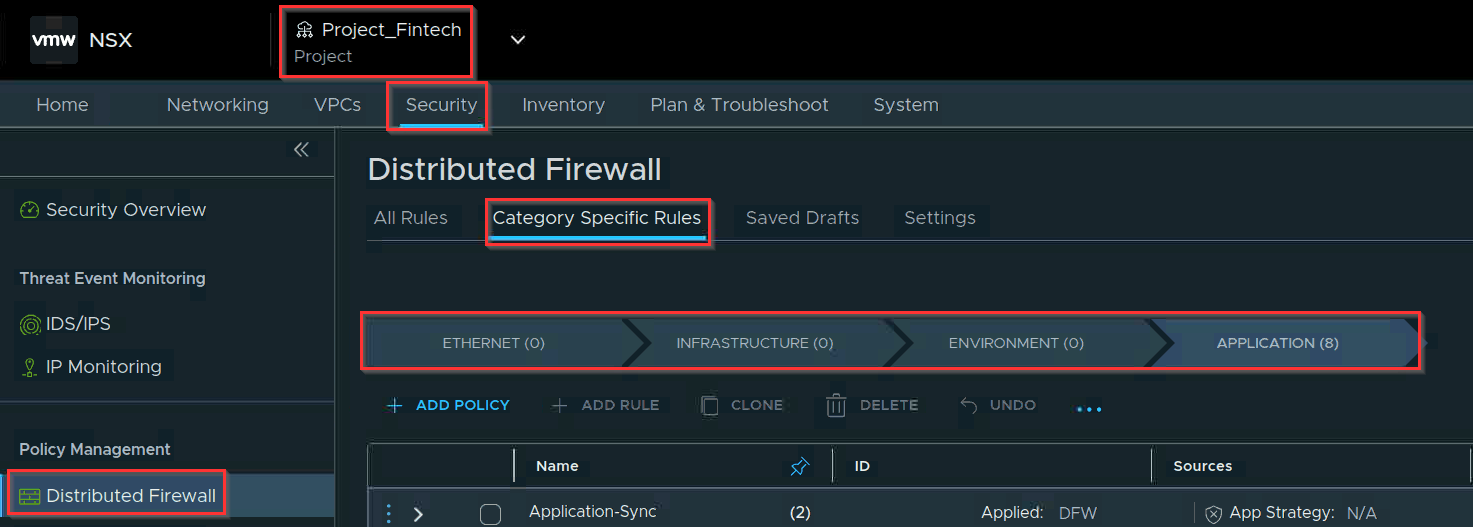
Architecture Check: Notice that the Emergency category is completely hidden from the Project UI, and the Infrastructure category displays 0 tenant rules. This confirms that the Default Space rules retain evaluation priority.
Capture 3: –
Application category restricting enforcement strictly to these vNICs
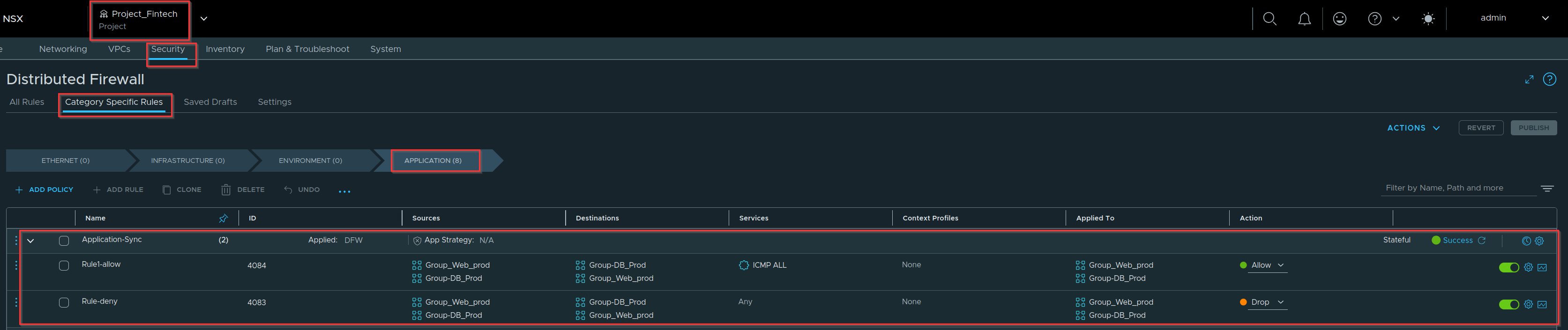
Verification and Troubleshooting via CLI & Traceflow
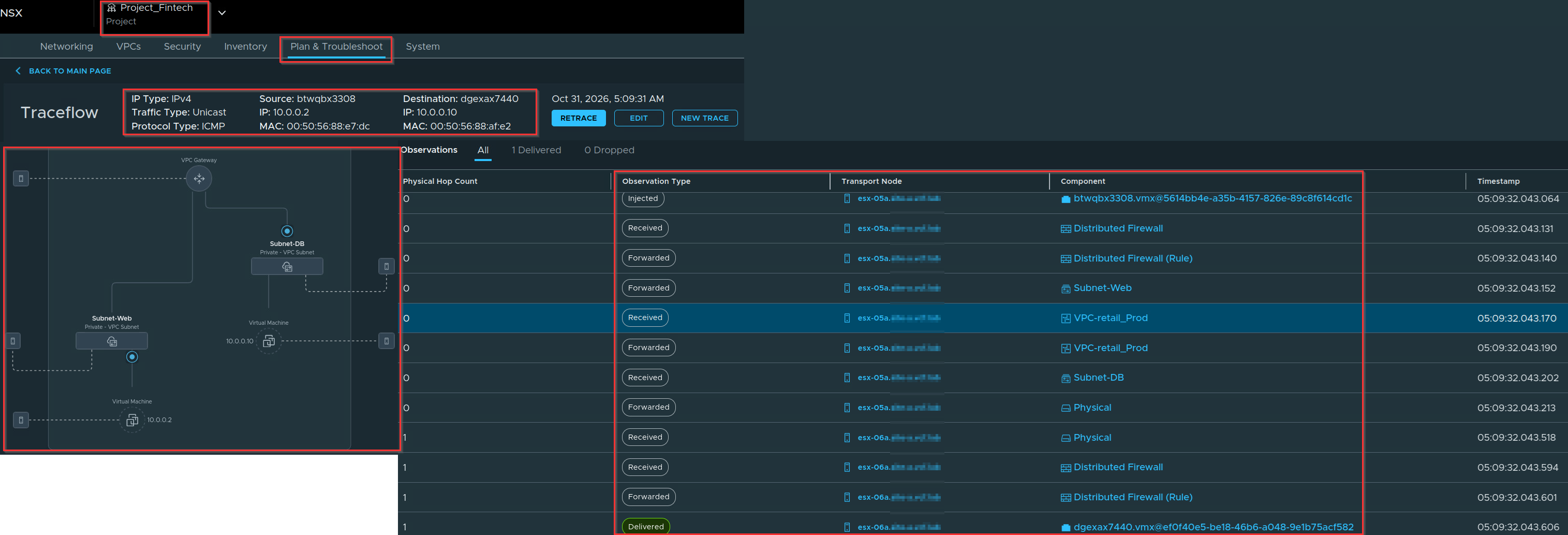
Test 1: Verify Bi-Directional ICMP Diagnostics
From the console of Web VM btwqbx3308 (10.0.0.2), execute a ping against the DB VM Dgexax7440 (10.0.0.10):
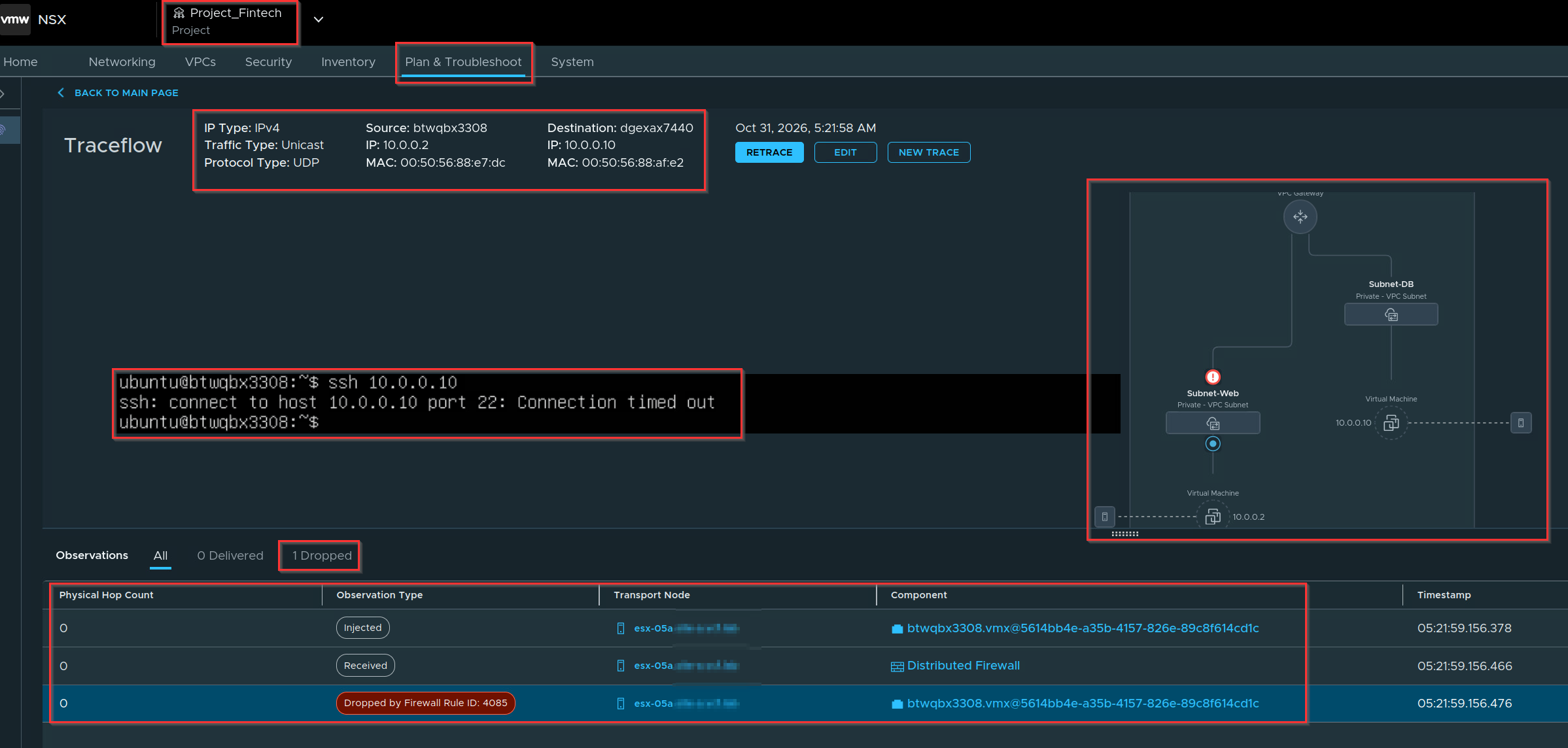
Test 2: Verify Lateral SSH Blocking
From btwqbx3308, attempt an SSH connection to Dgexax7440
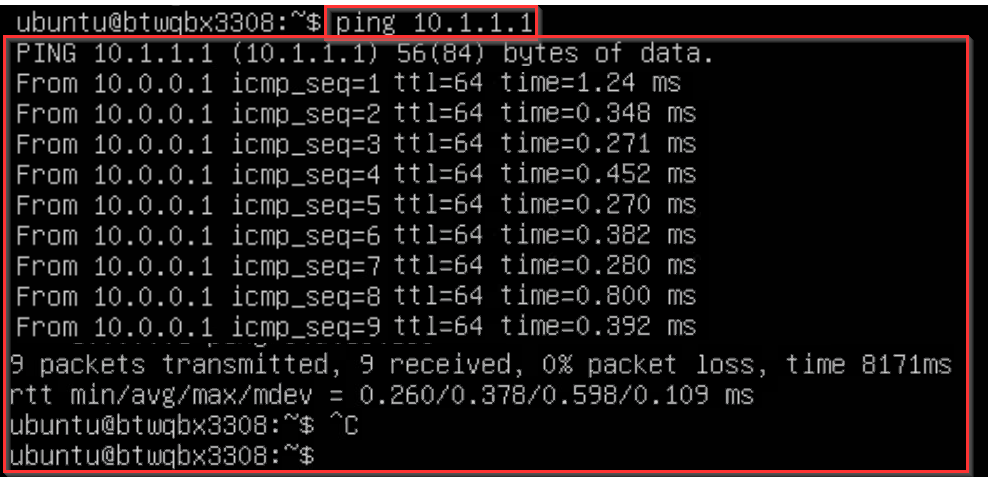
Test 3: Validate Global Infrastructure Precedence
From btwqbx3308, verify DNS resolution against the shared server (10.1.1.1):
Conclusion
Micro-segmentation across VCF 9.1 Projects and VPCs achieves a robust operational equilibrium between enterprise governance and developer velocity. By anchoring mandatory threat prevention and shared services in the Emergency and Infrastructure tiers while delegating Application rule creation to tenant project spaces, organizations can empower DevOps teams to secure workloads dynamically without exposing the global fabric. Paired with Centralized Transit Gateway Firewalls for perimeter and inter-VRF control, VCF 9.1 establishes a true zero-trust multi-tenant cloud architecture.
For official design documentation, reference architecture blueprints, and configuration procedures, consult the official Broadcom TechDocs guides below:
- 🔗 Secure VPC and Projects Architecture — Broadcom TechDocs (vDefend Firewall 9.1)Official guide covering multi-tenancy constructs, roles, DFW security strategies, and rule application models within NSX Projects and VPCs.
- 🔗 Configuring Centralized Transit Gateway Firewalls — Broadcom TechDocs (vDefend Firewall 9.1)Details North-South isolation, attachment scoping, inter-VRF routing firewalls, and Provider
/infrapolicy precedence over tenant VPC rules.


Leave a Reply