

Introduction
Implementing Zero-Trust data-in-motion compliance within legacy private clouds introduces a severe performance trade-off: executing real-time symmetric encryption (AES) on gigabytes of active memory packets saturates general-purpose x86 CPU cores. During large-scale DRS balancing or host evacuations, this software-driven cryptographic penalty spikes host CPU utilization above 80%, limits throughput, increases migration latency, and starves adjacent workloads.
VMware Cloud Foundation (VCF) 9.1 addresses this resource bottleneck by introducing native hypervisor data-plane integration for Intel QuickAssist Technology (QAT) Hardware Offload. Utilizing specialized, kernel-level crypto-shims, the ESXi kernel intercepts the vMotion memory stream and shunts the cryptographic load directly onto physical Intel QAT silicon. By delegating processing away from the main hypervisor CPU scheduler, VCF 9.1 reclaims up to 70% of host compute capacity, ensuring unhindered application performance while maintaining end-to-end cryptographic enforcement.
The Architectural Breakthrough: Moving from Software to Silicon
The most critical difference between secure mobility in VCF 9.0 versus VCF 9.1 is where the cryptographic workload is processed. The transition moves data plane security out of the software compute scheduler and locks it directly into physical acceleration chips.
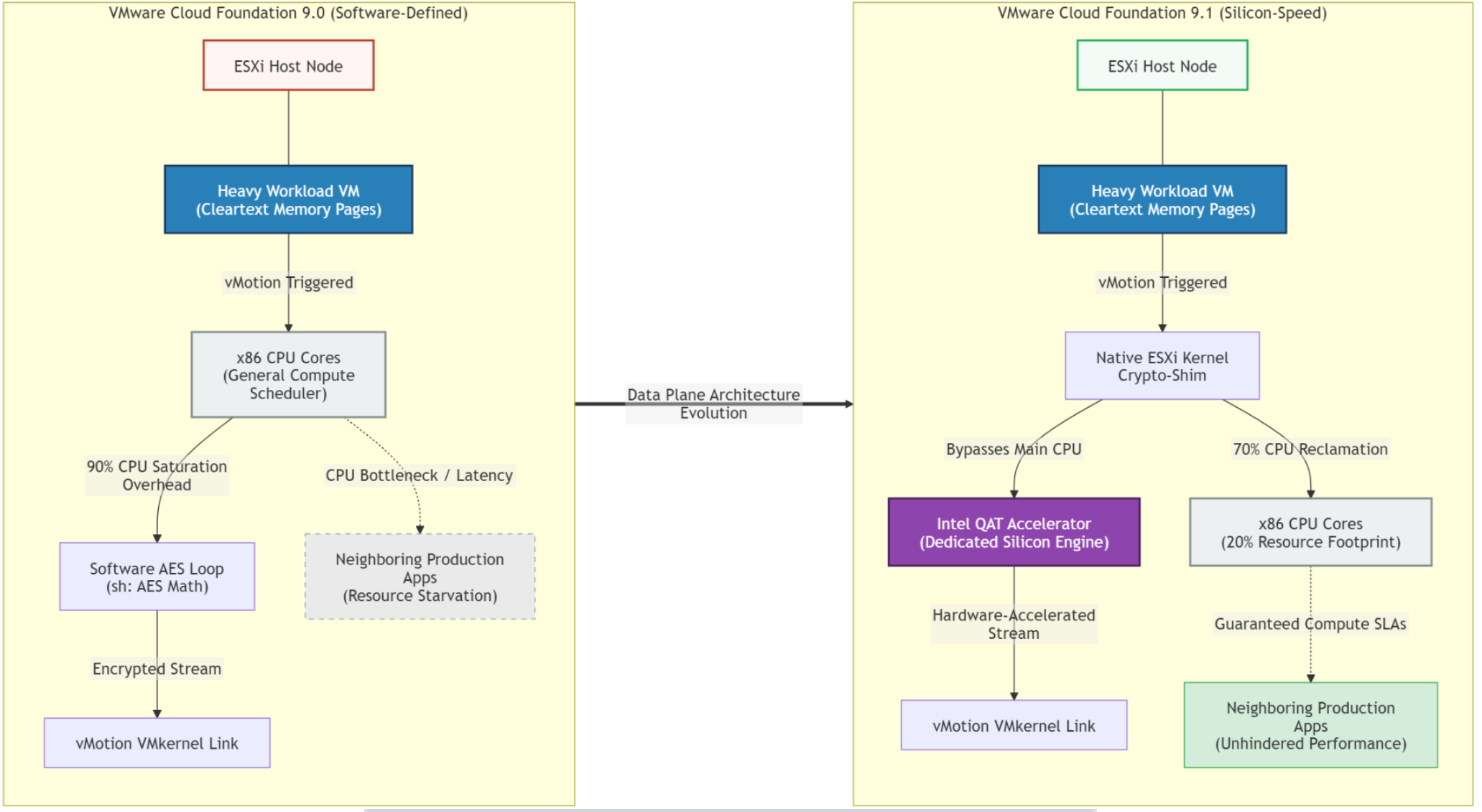
VCF 9.0 : Software-Defined Encryption
Historically, activating Encrypted vMotion forced the ESXi hypervisor to utilize standard software cycles from the primary x86 CPU cores. When a migration is initiated, the kernel scrambles the VM memory pages before transmission. As data rates climb over high-speed networks, this software AES loop creates a localized resource bottleneck, starving adjacent VMs (labeled ‘Neighboring Production Apps’) of compute power. This resource conflict creates performance lag, forcing operations teams to restrict or sequentialize maintenance windows.
VCF 9.1: Silicon-Layer Hardware Offload
VCF 9.1 utilizes a native ESXi kernel crypto-shim to bypass the main host processor, routing the vMotion memory data plane directly to built-in Intel QAT silicon engines. Offloading cryptographic and compression math directly to dedicated hardware achieves up to 70% CPU reclamation. This isolates the hypervisor scheduling pipeline from encryption overhead, allowing adjacent production workloads to sustain unhindered performance levels.
| Architectural Capability | VMware Cloud Foundation 9.0 | VMware Cloud Foundation 9.1 |
| Cryptographic Engine | Software-defined (x86 CPU Cycles) | Hardware-Accelerated (Intel QAT Silicon) |
| Host CPU Overhead penalty | High Core Saturation (Up to 80%+) | 70% CPU Reclamation (Flatlined Overhead) |
| Workload DRS Balancing | Sequential Batching Limitations | Accelerated Parallel Rebalancing |
| Daytime Upgrade Feasibility | Restricted (Risk of neighboring VM lag) | Fully Supported (Zero application SLA impact) |
Control-Plane Encryption: vSphere NKP
Before a single memory packet can be scrambled over the wire, the hypervisor fabric requires a reliable cryptographic infrastructure to generate, distribute, and track encryption keys. To eliminate the deployment complexity and overhead of third-party external Key Management Servers (KMS) running KMIP protocols, VCF leverages the built-in vSphere Native Key Provider (NKP).
The following architectural matrix details why the embedded Native Key Provider is the chosen choice for accelerating data-in-motion encryption over external market alternatives (like Thales CipherTrust, Entrust KeyControl, or HashiCorp Vault):
| Architectural Pillar / Challenge | External KMIP KMS Execution Path | vSphere Native Key Provider (NKP) Architecture |
| Session Key Distribution | Requires external Key Management Interoperability Protocol (KMIP) daemons to negotiate keys over the network, introducing network latency and public key infrastructure (PKI) certificate management overhead. | Control-Plane Integrated: Generates and distributes ephemeral, single-use 256-bit Data Encryption Keys (DEKs) directly within the core hypervisor management layer per migration session. |
| Lifecycle & State Management | Operates as an independent infrastructure domain requiring distinct patch lifecycles, dedicated administrative boundaries, and isolated high-availability clustering. | Kernel Encapsulated: Inherits the native vCenter Server high-availability fabric. Cryptographic state maps directly to standard vCenter database backup and restore sequences. |
| Circular Boot Dependency | Virtualizing an external KMS within an encrypted datastore causes an initialization deadlock during a cold start: hosts cannot mount storage without keys, and the KMS VM cannot boot without storage access. | Host-Cached Key Derivation: Distributes a permanent Key Derivation Key (KDK) to local ESXi memory caches and physical hardware TPM 2.0 chips, enabling autonomous local storage decryption. |
| Resource Licensing & Cost | Requires external node-based or core-indexed third-party ISV software licensing entitlements. | Native Monolithic Entitlement: Embedded directly into the base vSphere/VCF hypervisor feature set with zero external licensing prerequisites. |
Deep Dive: The Data-in-Motion Life Cycle
A common misconception among infrastructure teams is that an encrypted virtual machine migration penalizes the internal performance of the application during transit. In reality, vSphere enforces a strict boundary between data-at-rest processing and data-in-motion security.
When Encrypted vMotion is enforced, the virtual machine continues to execute instructions in cleartext within the host’s protected RAM space. The guest operating system and the active application remain entirely unaware that a migration is taking place. The encryption boundary exists exclusively within the hypervisor kernel network stack.
The Lifecycle Workflow: Encrypted over the Wire, Decrypted in Memory
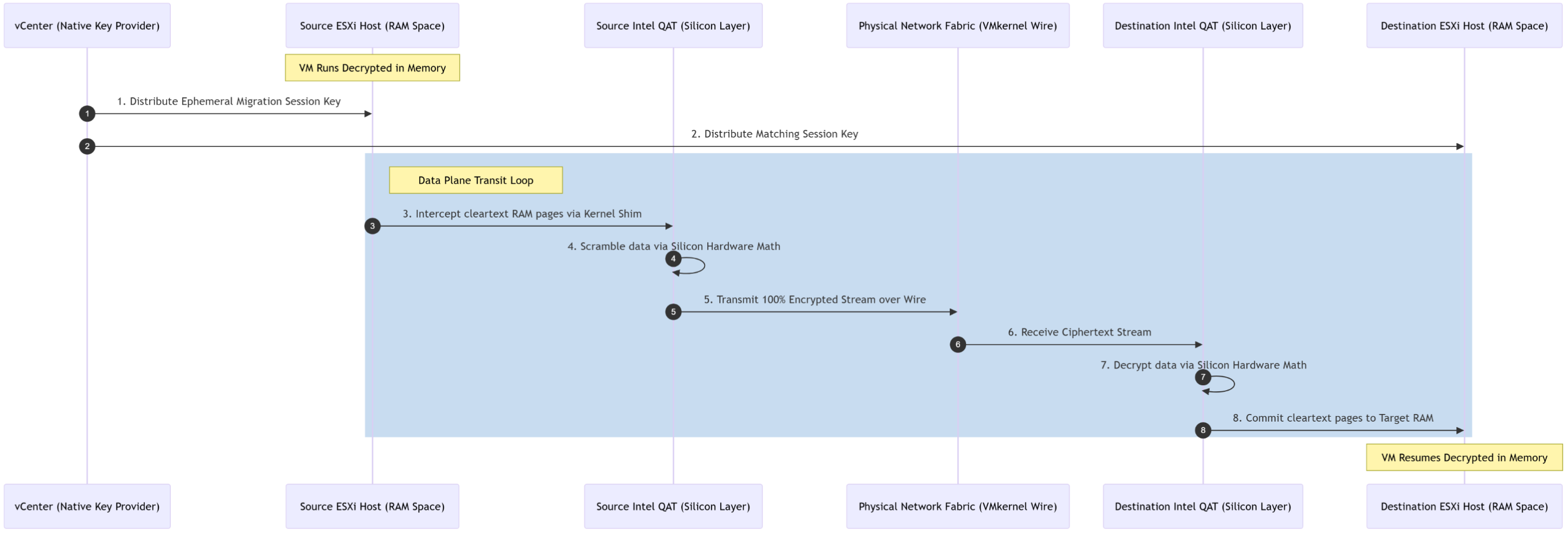
Key Generation: vCenter requests a unique migration key pair from the Native Key Provider.
- Silicon Intercept: As the ESXi kernel memory scheduler reads the VM’s active RAM blocks, a native VCF 9.1 crypto-shim redirects the data pages away from the standard x86 CPU threads and routes them to the physical Intel QAT silicon engine.
- The Secure Wire: The Intel QAT engine scrambles the memory pages at hardware speed, streaming the data across the vMotion VMkernel network as an encrypted payload.
- Target Reception & Decryption: The destination ESXi host receives the encrypted stream. Its local Intel QAT engine handles the hardware-level decryption, instantly presenting the cleartext memory pages to the target host’s isolated RAM space. The VM continues execution seamlessly on the new host node.
Validation
Phase 1: Bootstrapping the vSphere Native Key Provider
Before configuring our test workload, we must activate the native cryptographic subsystem within our vCenter inventory.
Capture 1: –
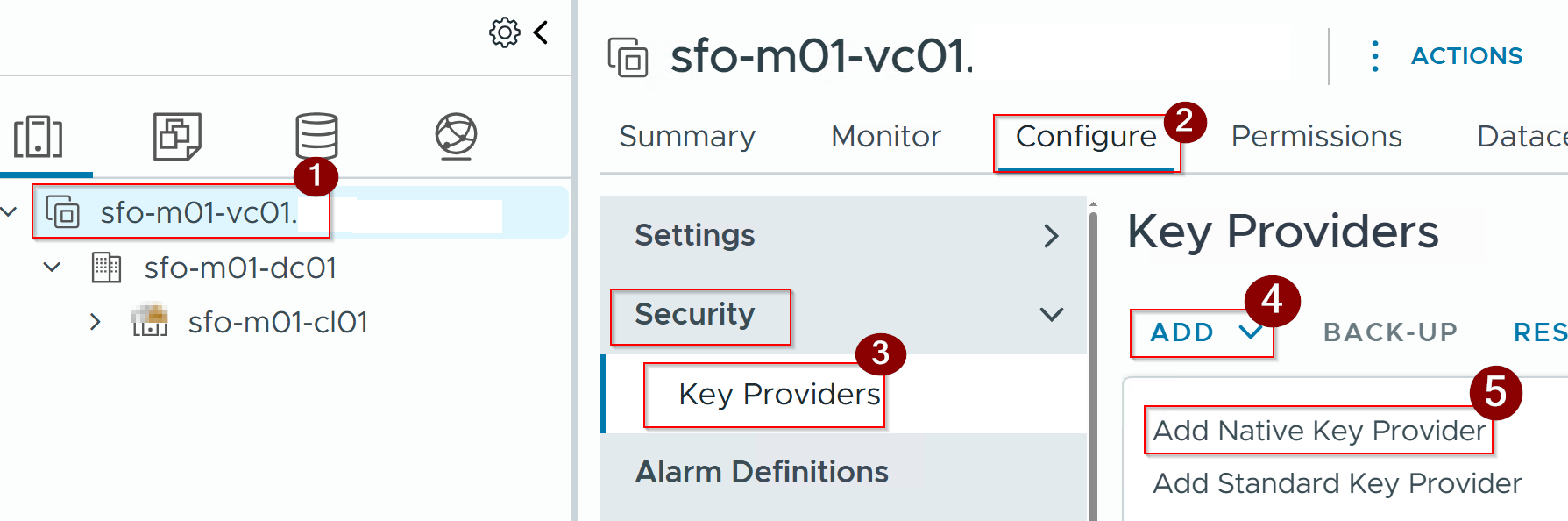
- Select the top-level vCenter Server Node.
- Click the Configure tab.
- Scroll down to the Security section -> Select Key Providers.
- Click Add.
- Choose Add Native Key Provider.
Capture 2: –
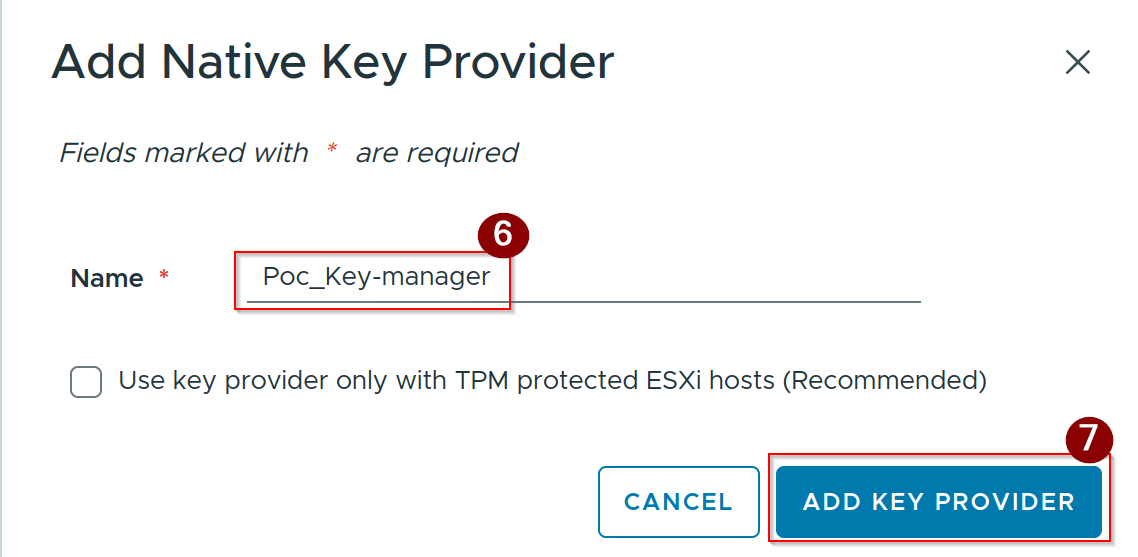
6. Configure the parameters –>Name: POC-Key-manager.
7. Click on ADD KEY PROVIDER.
Capture 3:-
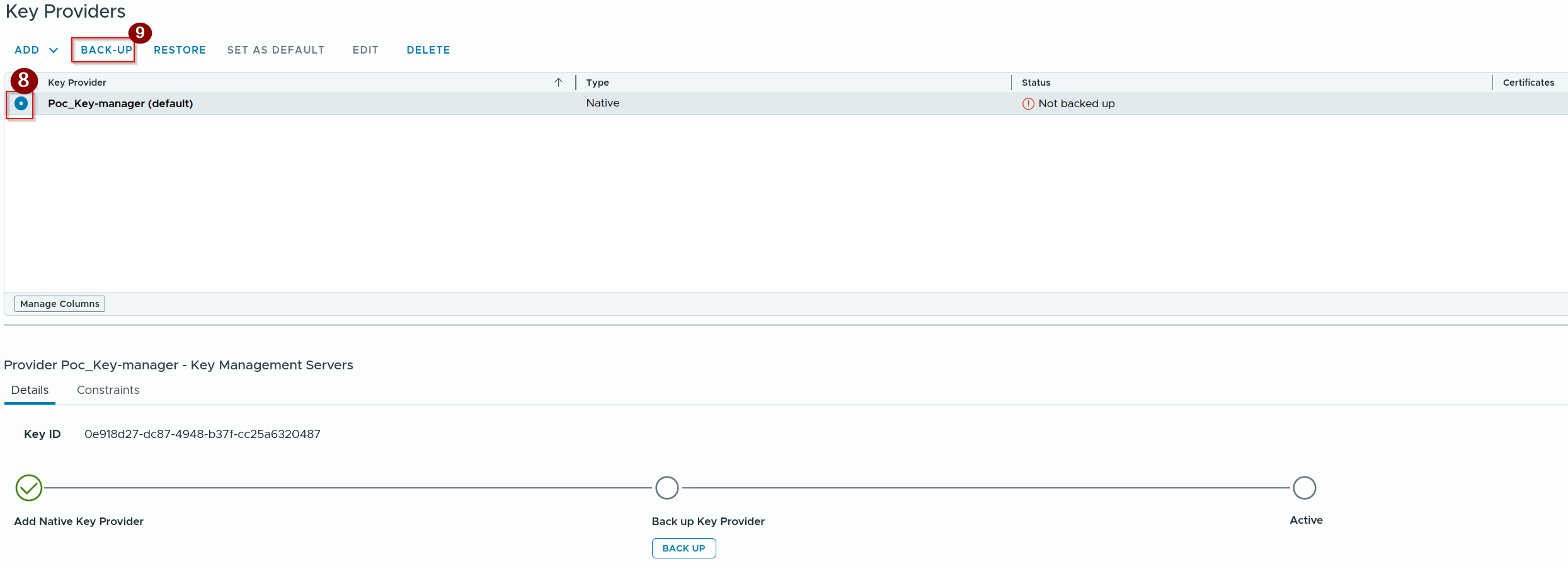
8. Select the Radio button.
9. Click on backup.
Capture 4: –
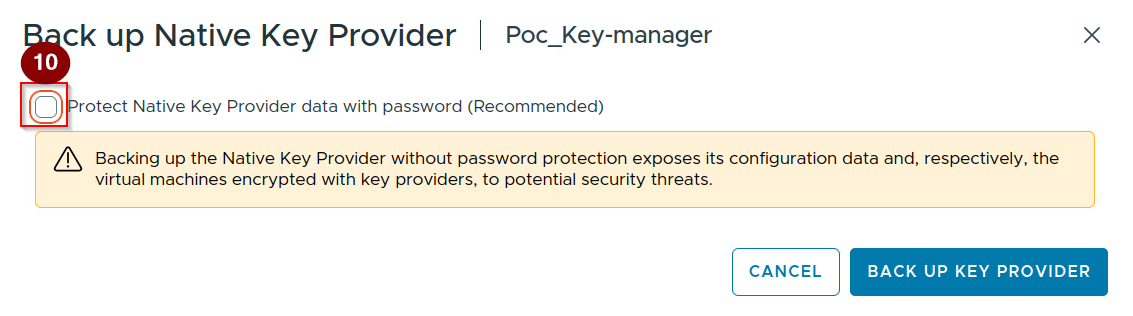
10. Click on radio button.
Capture 5: –
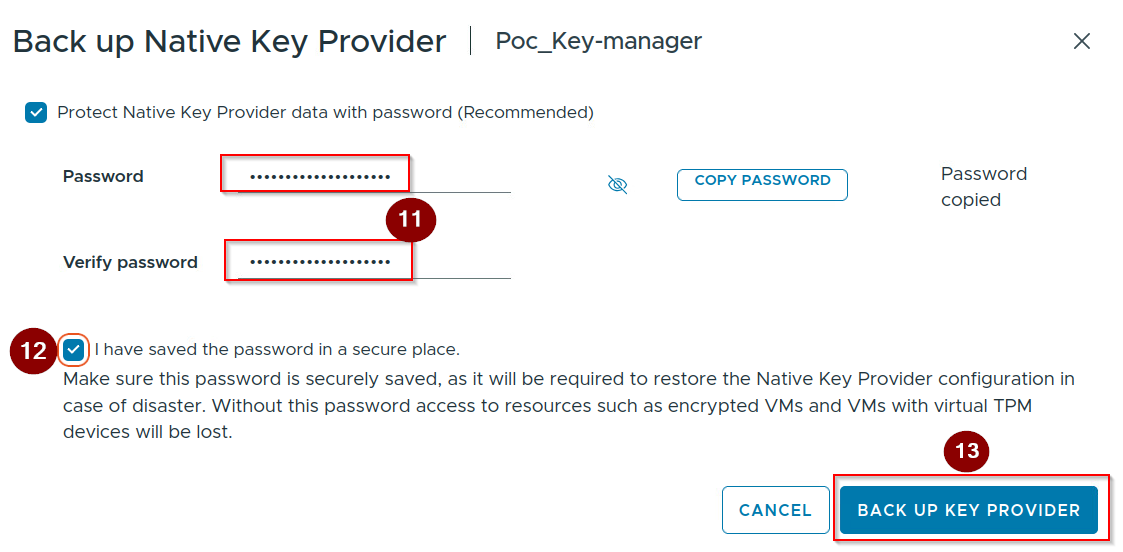
11. Assign the password.
12. Select the box.
13. Click on BACK UP KEY PROVIDER.
Capture 6: –
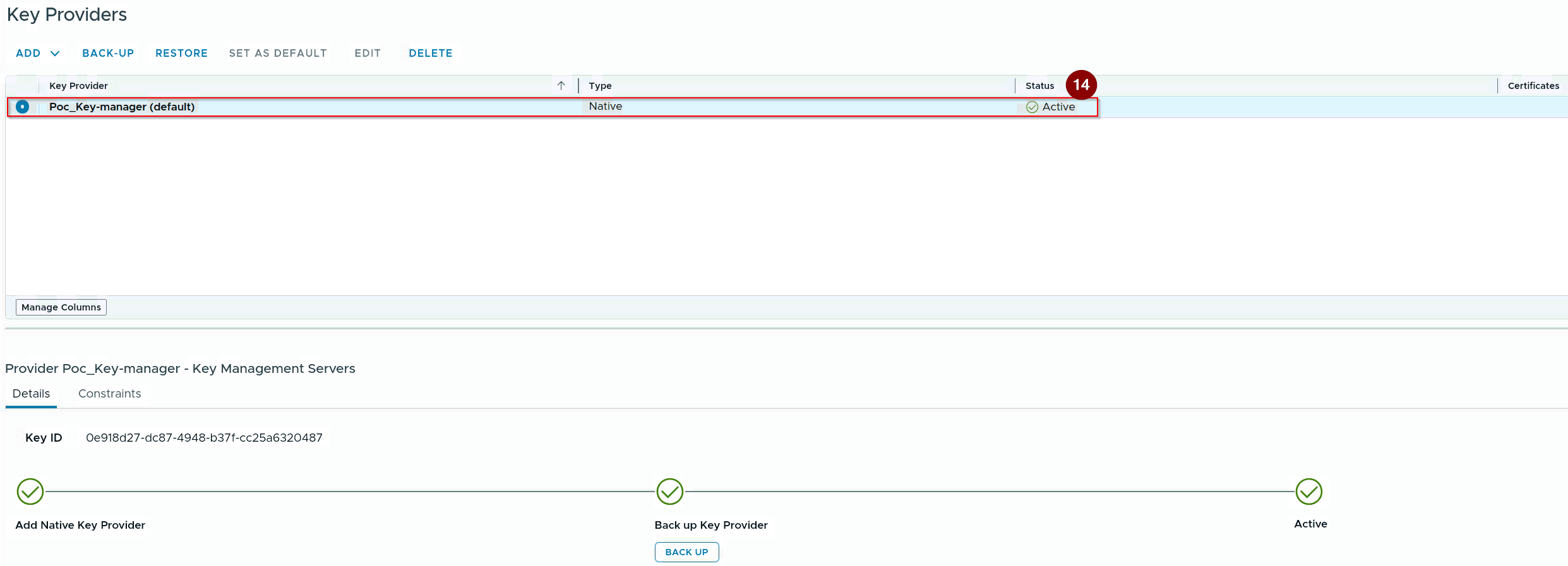
14. Complete the wizard to download the backup file. The status indicator will transition to a green Active state.
Phase 2: Enforcing the Security Policy Guardrail
With the key engine online, we select our test workload, Prod-test, and enforce strict cryptographic transport protection.
Capture 1: –
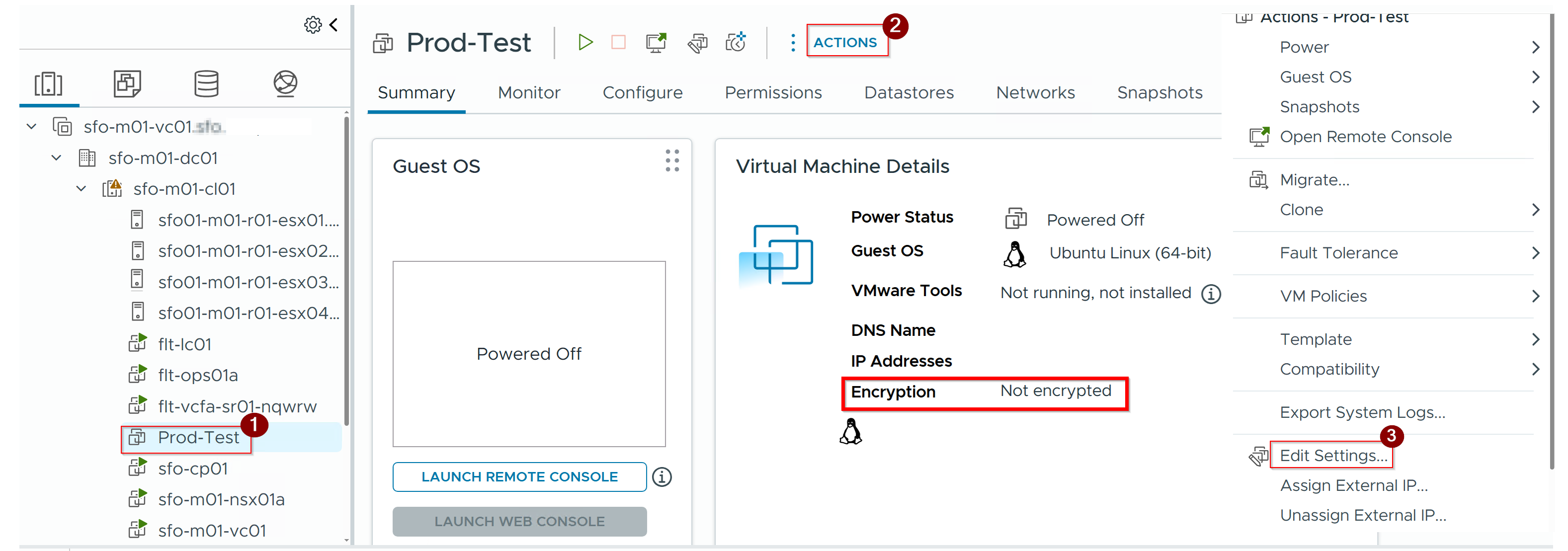
- Select the VM (
Prod-test).
Note: – Ensure the VM is powered down to unlock structural descriptor modifications. - Click On Actions.
Note:- VM is not encrypted. - Click Edit Settings.
Capture 2: –
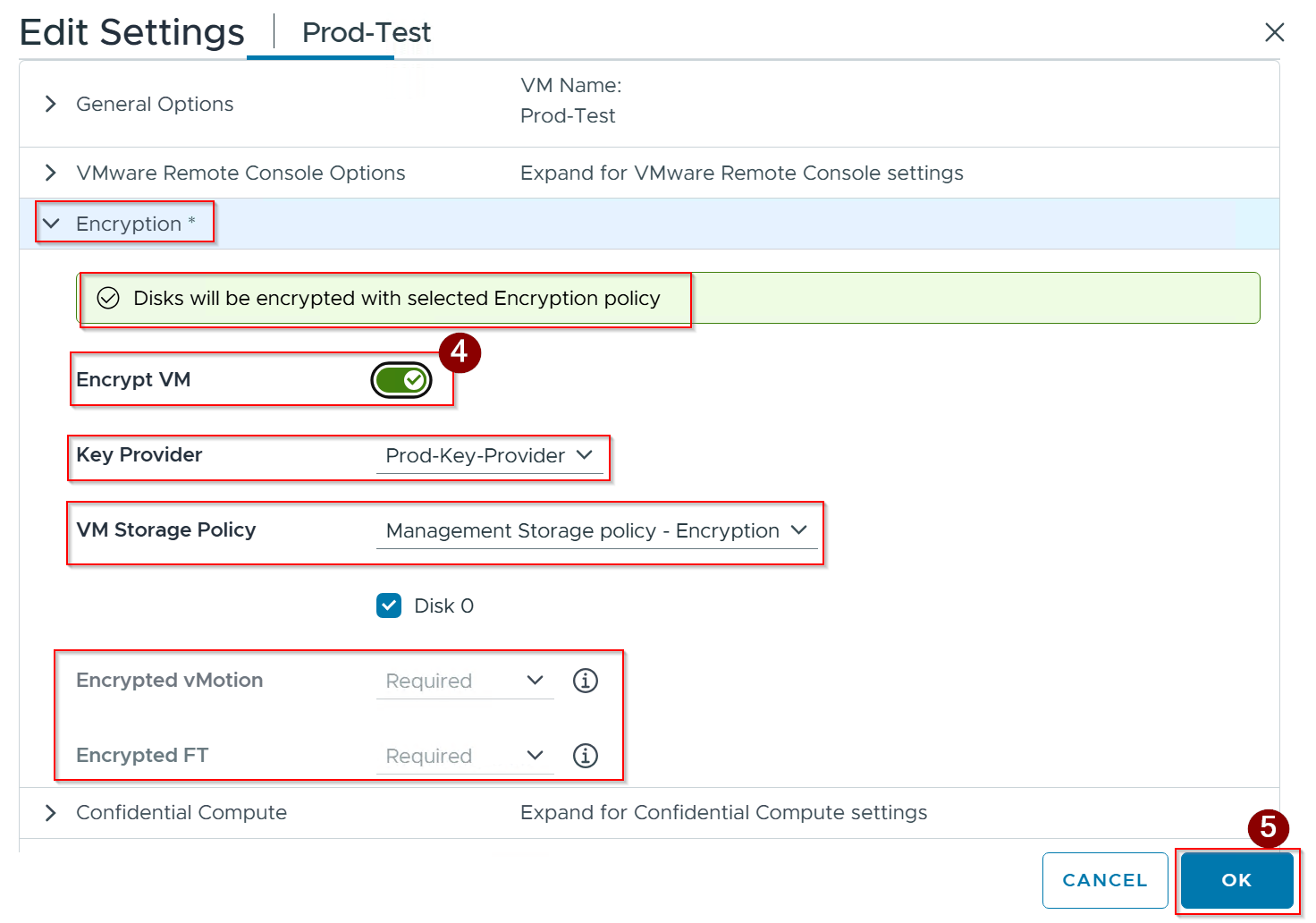
Select the VM Options tab -> Expand the Encryption tree.
4. Drag the button of Encrypt VM.
Note : – Make sure the Encrypted vMotion & Encrypted FT dropdown from Opportunistic to Required.
5. Click Save.
Note: – Encryption polices applied on the VM to comply with the data-in-motion encryption for compliance audits.
Capture 3: –
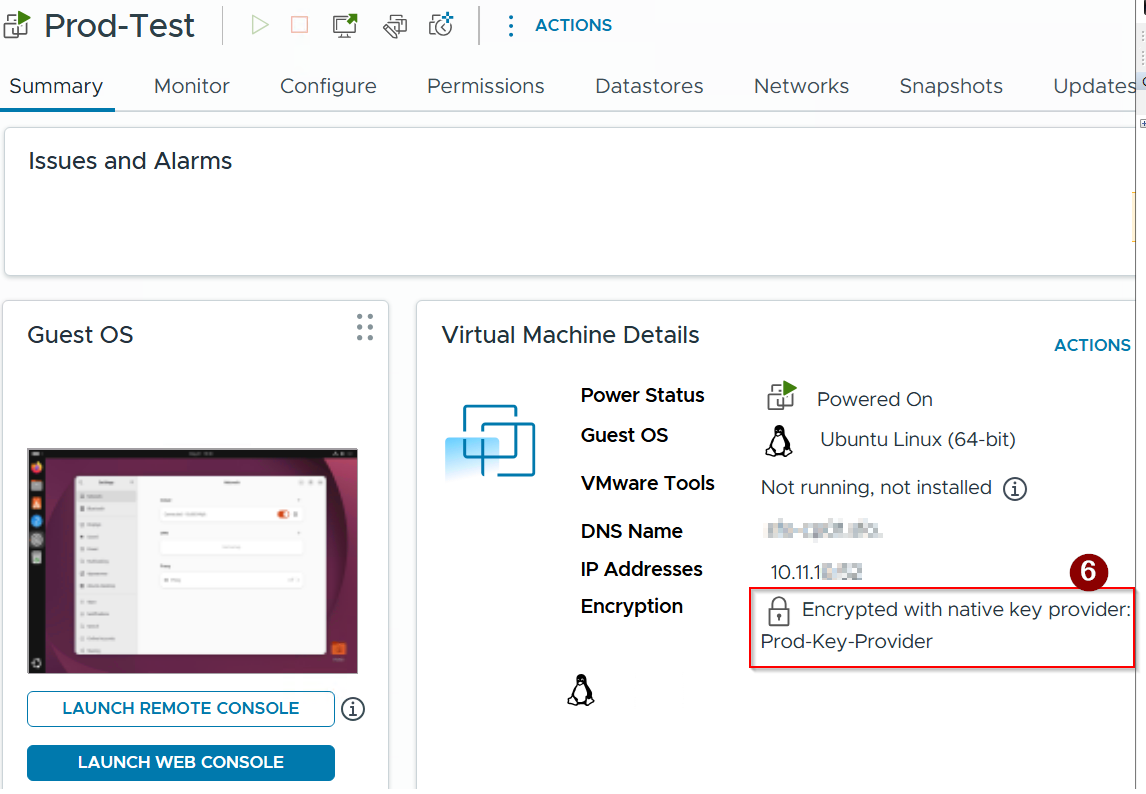
6. We can see the VM is encrypted with Native Key provide policy.
Phase 3: Validating Kernel Readiness via the CLI
Production Hardware Verification Note: > Nested virtualization abstracts physical silicon behind Class 0604 PCI bridges. For bare-metal validation, verify the active Intel QAT generation by running lspci -v and matching the hex device IDs against the hardware matrix below:
| Intel QAT Generation | Common Hex Device IDs | Targeted Processor Architecture |
| QAT Gen 4 / 5 (Hardware v2.0) | 4940, 4942, 4944, 4946 | Intel Xeon Sapphire Rapids / Emerald Rapids / Granite Rapids |
| QAT Gen 3 (Hardware v1.x) | 37c8, 19e2, 0435, 6f54 | Legacy Intel Xeon Scalable Platforms |
To verify that our local ESXi transport node has successfully initialized its cryptographic daemons and registered the new session parameters, establish an SSH session as root to the designated cluster host.
First, execute the native host-level encryption verification queries:
Capture 1:-

- Run the cmd
esxcli system settings encryption get
Note:- Mode is None.
The default state. The archived ESXi configuration backup is encrypted via an internal software key stored within the hypervisor file structure but is not bound to a hardware anchor.
Capture 2: –
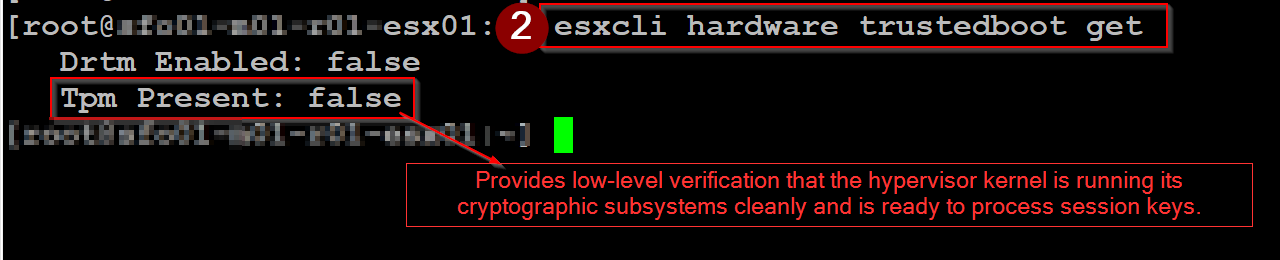
2. Run the cmd
esxcli hardware trustedboot get
Note: – TPM Present: False
The ESXi configuration key is cryptographically sealed to a physical hardware TPM 2.0 (Trusted Platform Module) chip inside the server chassis. The host will refuse to decrypt its configuration or boot if the hardware state is altered.
Capture 3: –

- Run the cmd
find /vmfs/volumes/ -name “Prod-Test.vmx”
Note: because vSAN structures object directories using complex Universally Unique Identifiers (UUIDs) rather than friendly inventory names, locate the absolute storage path of the virtual machine’s configuration descriptor (.vmx) file using the system-wide lookup engine.
Capture 4: –

2.Run the cmd
grep -E -i “keySafe|ftcpt.ftEncryptionMode|migrate.encryptionMode” /vmfs/volumes/vsan:5226c175b9ee43a0-841459749077843e/328c1a6a-0f2e-28be-4e7d-0050568d96c6/Prod-Test.vmx
Note: –migrate.encryptionMode = "required" confirms that data-in-motion encryption is actively enforced.
The URL-encoded (%2d(Prod%2dKey%2dProvider)) fqid string confirms the virtual machine is cryptographic-bound to the Prod-Key-Provider authority.
Phase 4: Measuring the Performance Footprint via esxtop
To evaluate data-plane resource consumption, real-time system profiling metrics are captured via esxtop from the host CLI. System execution behavior is monitored across two distinct operational states: the pre-migration baseline on the source node (esxi-01) and the post-migration landing state on the destination node (esxi-02).
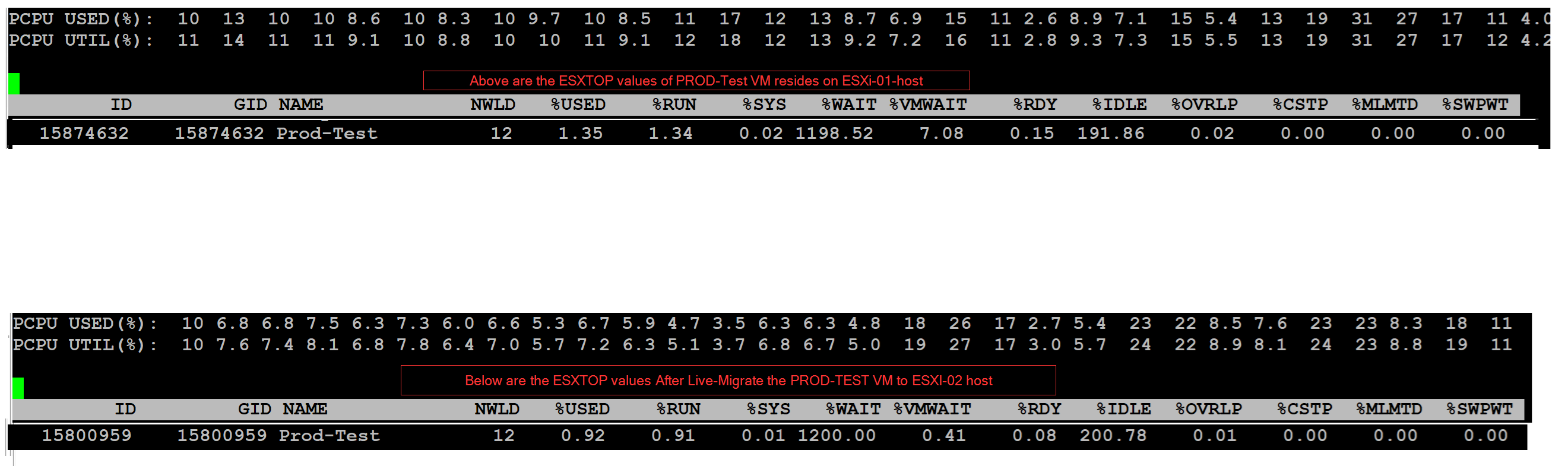
| esxtop Execution Metric | Source Host (ESXi 01) – Pre-Migration Baseline | Destination Host (ESXi 02) – Post-Migration Landing |
| VM World Runtime ID | 15874632 | 15800959 |
Active Virtual Threads (NWLD) | 12 | 12 |
Total CPU Allocation (%USED) | 1.35% | 0.92% |
Scheduled CPU Time (%RUN) | 1.34% | 0.91% |
Hypervisor Kernel Overhead (%SYS) | 0.02% | 0.01% |
Co-Scheduler Latency (%RDY) | 0.15% | 0.08% |
Physical Core State (PCPU UTIL %) | Bounded (Averaging 9%–15% across threads) | Bounded (Averaging 5%–8% across threads) |
Negligible Workload Footprint: Total VM resource consumption (%USED) remains constant at a minimal 1.35% on the source and 0.92% on the destination, proving mandatory encryption imposes zero runtime performance penalty.
Sustained Hypervisor Efficiency: Exceptionally low host ready states (%RDY at 0.08%) and system overhead (%SYS at 0.01%) demonstrate that the kernel avoids scheduling queue delays, safely guaranteeing adjacent production SLAs.
Conclusion
VMware Cloud Foundation 9.1 native Intel QAT integration decouples symmetric cryptographic processing from the x86 pipeline, reclaiming up to 70% of host compute capacity during Encrypted vMotion. By shifting encryption tasks onto specialized silicon via kernel shims, VCF 9.1 allows architects to enforce strict data-in-motion compliance without sacrificing workload SLAs or cluster balancing efficiency. Secure transport is no longer a software performance penalty—it is a zero-overhead, silicon-speed default.
Reference Citations
- Broadcom Technical Review: Click here
- Broadcom Platform Announcement: Click Here
- vSphere Native Key Provider:Click Here


Leave a Reply